- The US expects Russian troops could move soon into Donbas, a senior US official familiar with latest intelligence said.
- The US and UK plan to impose sanctions against Russia, with several other countries saying Monday they were prepared to do the same, including Japan, Australia and Lithuania.
- The Ukraine ambassador to the UN said at a hastily arranged emergency meeting of the UN Security Council yesterday that the decision to recognize pro-Moscow regions was “illegal and illegitimate”.
Wednesday, February 23, 2022
USDJPY, H4 | Potential Bearish Continuation
from Tickmill Expert Blog - Forex Traders Blog https://www.tickmill.com/blog/usdjpy-h4-or-potential-bearish-continuation"
via IFTTT
NZDUSD, H4 I Potential Rise
from Tickmill Expert Blog - Forex Traders Blog https://www.tickmill.com/blog/nzdusd-h4-i-potential-rise"
via IFTTT
USDCAD, H4 | Potential Bearish Continuation
from Tickmill Expert Blog - Forex Traders Blog https://www.tickmill.com/blog/usdcad-h4-or-potential-bearish-continuation"
via IFTTT
USDCHF, H4 | Potential Bearish Continuation
from Tickmill Expert Blog - Forex Traders Blog https://www.tickmill.com/blog/usdchf-h4-or-potential-bearish-continuation"
via IFTTT
Market Update – February 23 – Oil, Gold & Bond ebbs; Kiwi jumps
Stocks stabilised and indexes came up from yesterday’s lows, as markets digest the still fluid developments in the Ukraine and the standoff between the West and Russia. Haven demand eased and yields backed up. President Biden announced sanctions on Russia, including financial restrictions. Earlier Germany halted Nord Stream 2. UK will stop Russia selling sovereign debt in London. The RBNZ lifted its policy rate by 25 bp to 1.00%, adding to signs that central banks are moving out of crisis modus and set on policy normalisation. Governor Bowman opened the door for a 50 bp liftoff next month. Gold below $1900, Oil seattled at $90.50. Treasury yields cheapened with the front end underperforming on worries over aggressive rate hikes to help contain inflation.
- USD down (USDIndex 95.11) as risk appetite has stabilised.
- US Yields 10-year yield richened to 1.844% overnight before climbing to 1.958% before settling at 1.925%.
- Equities – GER30 and UK100 futures are up 0.6% and 0.1% respectively, while a 0.7% rise in the USA100 is leading US futures higher.
- USOil – Steady at $90.50 as sanctions neither appear as harsh as could have been.
- Gold – dipped as haven demand ebbed – below $1900.
- Bitcoin broke higher to trade at $38,388.
- FX markets – NZDUSD jumped to 0.6776, EURUSD at 1.1340, USDJPY steady at 115.00. Cable breaches 1.3600.
European Open – German consumer confidence unexpectedly dropped to -8.1 in the advance reading for March. The March 10-year Bund future is down -4 ticks, Treasury futures are outperforming slightly, although the German 30-year future also seems to be benefiting from the prospect of reduced ECB support as surveys signal a swift rebound from the latest virus wave, but also mounting inflation pressures. Risk appetite has stabilised somewhat, although markets will keep a weary eye on Ukraine and the standoff between the West and Russia. For now though the focus seems back on central banks and the Fed’s tightening schedule.
Today – Today’s local calendar includes the final Eurozone HICP number, which will highlight once again that inflation is staying higher for much longer than initially expected. That in turn is putting pressure on the ECB to reign in stimulus. The UK has the latest retailing survey, which should register the easing of virus restrictions.
Biggest FX Mover @ (07:30 GMT) NZDJPY (+0.74%) Spiked to 78 highs earlier. MAs now aligned higher, MACD signal line & histogram significantly above 0 line, RSI 72.66& rising. H1 ATR 0.155, Daily ATR 0.781.
Click here to access our Economic Calendar
Andria Pichidi
Market Analyst
Disclaimer: This material is provided as a general marketing communication for information purposes only and does not constitute an independent investment research. Nothing in this communication contains, or should be considered as containing, an investment advice or an investment recommendation or a solicitation for the purpose of buying or selling of any financial instrument. All information provided is gathered from reputable sources and any information containing an indication of past performance is not a guarantee or reliable indicator of future performance. Users acknowledge that any investment in Leveraged Products is characterized by a certain degree of uncertainty and that any investment of this nature involves a high level of risk for which the users are solely responsible and liable. We assume no liability for any loss arising from any investment made based on the information provided in this communication. This communication must not be reproduced or further distribution.
from HF Analysis /313828/
via IFTTT
Dollar Up, Investors Look to the Latest Developments in Ukraine
from Forex News https://www.investing.com/news/forex-news/dollar-up-investors-look-to-the-latest-developments-around-ukraine-2769769
via IFTTT
Tuesday, February 22, 2022
Half of payments in Caracas performed in U.S. dollars - study
from Forex News https://www.investing.com/news/forex-news/half-of-payments-in-caracas-performed-in-us-dollars--study-2769434
via IFTTT
Britain mistakenly puts Russian central bank's address on sanctions list
from Forex News https://www.investing.com/news/forex-news/britain-mistakenly-puts-russian-central-banks-address-on-sanctions-list-2769403
via IFTTT
Canadian dollar firms as oil surges on Ukraine war fears
from Forex News https://www.investing.com/news/forex-news/canadian-dollar-firms-as-oil-surges-on-ukraine-war-fears-2769256
via IFTTT
Young people are becoming a scarce resource – we should value them more highly
Do you think the world has too many people or too few people? Odds are it’s the former. For decades now various types of Malthusians have been busily warning us that population explosion will destroy us all. They are wrong; it won’t.
At this point, what is more likely to destroy us, in the West at least, is the opposite. Even a cursory check of the numbers makes the point. In the majority of countries around the world the fertility rate has fallen below the replacement rate (this means an average of 2.1 children per woman). In many European countries it is far far below replacement rate. Think Italy at 1.27, Germany at 1.54, Spain at 1.24 and the UK at 1.6.
That doesn’t necessarily mean the global population isn’t going to end up unsustainably high – the UN is still forecasting a peak of well over ten billion people (up from 7.7 billion now). It’s just that all the growth it forecasts comes from just nine countries, all of which have very high fertility rates.
That sounds plausible – until you actually look at the numbers. One of the main drivers is supposed to be India. But in India the fertility rate is already down to 2.12. It is already barely a generation away from being Italy.
This is not to say populations in low fertility countries aren’t going to rise a bit more in the coming decades – they are. But what growth there is will be driven not by new people being born but by old people not dying – something that will mean that the number of the old relative to the young is going to just keep rising.
This represents a huge change: instead of a small number of old people being supported by a seemingly limitless number of young people, we are moving into a world where one of our most important resources – the young – is scarce. Between 2009 and 2019 the number of children in the UK rose by 8%; the number of people over 70 rose by 24%. Are we ready for this? The message of the Covid years is: no, not remotely.
Society has always been based around there being lots of young people and not very many old people. The result has been – more often than not – that the young have taken pretty good care of the old, working to pay for their pensions and healthcare, listening to their opinions and the like. Here we are with things the other way around – lots of old people; not so many young. How’s it going to work?
One’s first instinct might be to assume that society would adjust to be super supportive of the young. In a normal economic model, scarce resources are prized – and highly priced. In our world, our scarce resources are none of these things. That was the case before Covid, of course: pensioners got a triple lock on their pensions, students got to pay an interest rate on their student loans based on the retail price index (a measure of inflation that comes in around one percentage point higher than the more commonly used consumer price index) plus up to three percentage points more. Today it is 4.4% but with inflation at 7% plus it could soar to more like 10% soon. But their parents can get a mortgage for 2%.
The frantic money printing of the last decade has been equally anti-young – it has pushed up the prices of the assets older people own and made it even harder than it is in normal times for the young to build wealth.
The tax system seems stacked against them, too. We insist in the UK – for reasons that after 30 years in personal finance I still really can’t grasp – on charging lower tax rates on the income from assets (unearned income) than we do from work (earned income), and of course from refusing to charge capital gains tax on housing.
But all the financial irritations aside, nothing has shown up how oddly skewed we are approaching this than Covid policy. Instead of looking at our children, thinking carefully about how reliant we are on them and long term success – and so doing everything in our power to make them barely notice a pandemic that was never going to have much effect on their health, we have ruined two years of their lives (so far). We’ve closed their schools, limited their movements, criminalised their socialising, forced them to wear masks we know make no real difference. Worse, we’ve treated them differently – in a bad way – to adults.
Last week I got an email about a board meeting I had in Scotland. I was reminded in it that I was to wear a mask in the common areas of the office building but also assured that once I was in the meeting room itself, sitting down and talking with my colleagues, a mask was not required. At the same time my daughter was at school. Different rules applied to her: while sitting in her classroom (not talking) her mask was very much required – as it has been for the last 18 months.
Scottish parents joke, bitterly, that you can spot a Scottish secondary school student anywhere: they are the ones with mask-shaped acne around their noses and mouths.
Why different rules for adults and children? No idea. But it might be worth noting that the Scottish population is on average older than the English (where children have been mask-free for some time). Might it be that the older a population is, the less politicians care about kids?
Either way the results are obvious: the mental and physical health of children has declined. During the Covid years the percentage of children in reception rated obese or overweight has risen from 23% (already high) to 27.7%. The biggest leap has been among the most deprived children.
The truth is that throughout the last two years adults have been bizarrely unkind to children and young people – and that doesn’t bode well for the future. It might have made sense to put the needs of the old first when there weren’t very many of them. These days, when it is children who are becoming a scarce resource, it really doesn’t. Our politicians have some thinking to do.
from Moneyweek RSS Feed https://moneyweek.com/economy/604487/treat-young-people-better
via IFTTT
Ukrainian hryvnia loses 1% after Moscow recognises separatist regions
from Forex News https://www.investing.com/news/economy/ukrainian-hryvnia-loses-1-after-moscow-recognises-separatist-regions-2768854
via IFTTT
EURGBP – Retesting key support zones
EURGBP, H4
EURGBP continued its decline in February after the BoE decided to raise interest rates again to 0.5%, sending the pair back to trading at two-year lows slightly above 0.8300, with the EURUSD closing around 8 pips lower yesterday (February 21), a weekly low test, while GBPUSD closed about 8 pips higher, trying to break its weekly high.
As tensions between Russia and Ukraine continue market players are looking for trends in central bank policy. Markets expect the ECB to raise interest rates by 0.1% at its June meeting and by 0.5% before the end of the year, last week ECB chairman Lagarde emphasized the central bank’s unchanged stance regarding gradual implementation of policy. As for, the preliminary readings of the manufacturing PMI, the Eurozone for February was lower than expected at 58.4 versus 58.7 the previous month, while the services PMI was higher than expected, at a three-month high of 55.8 from 51.1 in January.
The preliminary February UK PMI data was in line with eurozone data, where the services PMI rose to an eight-month high of 60.8 compared with January’s 54.1, and the forecast of 55.6. Manufacturing PMI however, fell to the lowest in more than three months at 57.3 are the same as the previous month and slightly higher than the 57.2 forecast.
On the economic calendar today the German ifo economic survey beat expectations significantly at 98.9 versus expectations of 96.4. Later this week is testimony from BOE governor Bailey and MPC members on inflation and economic outlook before the UK Treasury Committee.
From a technical point of view the decline in the EURGBP pair in February is in a falling wedge pattern, and it is possible to see a reversal from the low 0.8310 zone where key resistance waits at the MA200 line at the 0.8360 zone. The next support line is at the lower frame line (yellow line) of the downtrend channel at the 0.8270 zone.
Click here to access our Economic Calendar
Chayut Vachirathanakit
Market Analyst – HF Educational Office – Thailand
Disclaimer: This material is provided as a general marketing communication for information purposes only and does not constitute an independent investment research. Nothing in this communication contains, or should be considered as containing, an investment advice or an investment recommendation or a solicitation for the purpose of buying or selling of any financial instrument. All information provided is gathered from reputable sources and any information containing an indication of past performance is not a guarantee or reliable indicator of future performance. Users acknowledge that any investment in Leveraged Products is characterized by a certain degree of uncertainty and that any investment of this nature involves a high level of risk for which the users are solely responsible and liable. We assume no liability for any loss arising from any investment made based on the information provided in this communication. This communication must not be reproduced or further distributed without our prior written permission.
from HF Analysis /313517/
via IFTTT
EGBs are rallying, stocks are selling off
Russian president recognised Donetsk and Luhansk as independent entities. This is a move that is expected to pave the way for Russia to claim any move in the area was support for an independent region rather than an invasion of the Ukraine. So far the response from the West unclear, but the EU said sanctions were on the table if those regions were recognized. Putin also denied he would be meeting with President Biden. Such a summit was also in doubt as it was contingent on no action from the Russia.
Putin’s announcement paved the way for Russia to openly send troops and weapons to the long-running conflict pitting Ukrainian forces against Moscow-backed rebels.
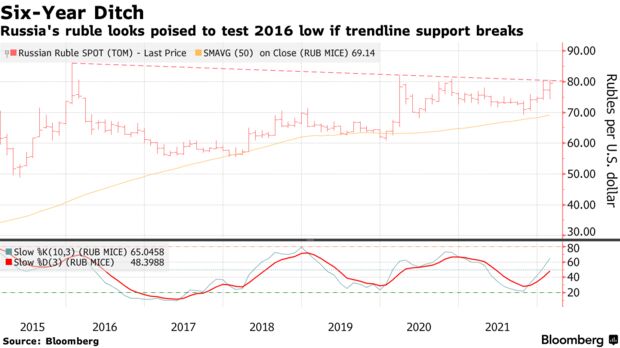
US Stock markets crashed into close (US100 -1.8% and the USA500 -1.2% lower). The GER30 dove -2.07%, while the UK100 dropped -0.39%. Asian markets slumped with the Nikkei falling -0.78%, with the CSI off -0.36%.-1.8%. Russia’s benchmark MOEX cratered -10.5%. USD was steady and gold — the traditional haven during upheavals — held gains. The ruble wavered. Gold rallied to test $1914, Oil Oil prices have dropped back from session highs, but remain markedly higher on the day, at 94.67. European equity futures shed more than 1.5%. Yields widened again but remain elevated. Treasuries climbed, taking the US 10-year yield below 1.90%.

European Open – The March 10-year Bund future is up 49 ticks, U.S. futures are outperforming as investors head for safety, while keeping a close eye on the developing situation in east Ukraine. The standoff between the West and Russia will keep pressure on stock markets, which already sold off yesterday and are set to correct even more today. DAX and FTSE 100 futures are currently down -1.1% and -0.7% respectively, while a -1.977% decline in the NASDAQ is leading US futures lower. In FX markets the yen was supported by safe haven flows and USDJPY dropped back to 114.68. EUR and GBP sold off, leaving EURUSD at 1.1304 and cable at 1.3586. Oil prices have dropped back from session highs, but remain markedly higher on the day, with WTI at USD 94.67 at the moment.
Today – Ukraine tensions will remain in focus and likely overshadow the calendar, which includes German Ifo readings as well as the U.K. industrial trends survey and U.K. public finance data and US PMI & Consumer Confidence.
Click here to access our Economic Calendar
Andria Pichidi
Market Analyst
Disclaimer: This material is provided as a general marketing communication for information purposes only and does not constitute an independent investment research. Nothing in this communication contains, or should be considered as containing, an investment advice or an investment recommendation or a solicitation for the purpose of buying or selling of any financial instrument. All information provided is gathered from reputable sources and any information containing an indication of past performance is not a guarantee or reliable indicator of future performance. Users acknowledge that any investment in Leveraged Products is characterized by a certain degree of uncertainty and that any investment of this nature involves a high level of risk for which the users are solely responsible and liable. We assume no liability for any loss arising from any investment made based on the information provided in this communication. This communication must not be reproduced or further distribution.
from HF Analysis /313477/
via IFTTT
USDJPY, H4 | Bearish Continuation
from Tickmill Expert Blog - Forex Traders Blog https://www.tickmill.com/blog/usdjpy-h4-or-bearish-continuation"
via IFTTT
Don’t count resources out
Commodities have performed poorly over the past year, but they tend to move in long and volatile cycles. from Moneyweek RSS Feed https://m...
-
The new strain of covid found in South Africa could disrupt plans by governments and central banks to rebuild economies. Financial markets a...
-
Fidelity “FIS” is a global financial services technology company and a leader in providing technology solutions to merchants, banks and cap...
-
Asian Equities Sink on Covid FearsIt’s been a mixed start to the week for global equities benchmarks with US and European asset markets rema...